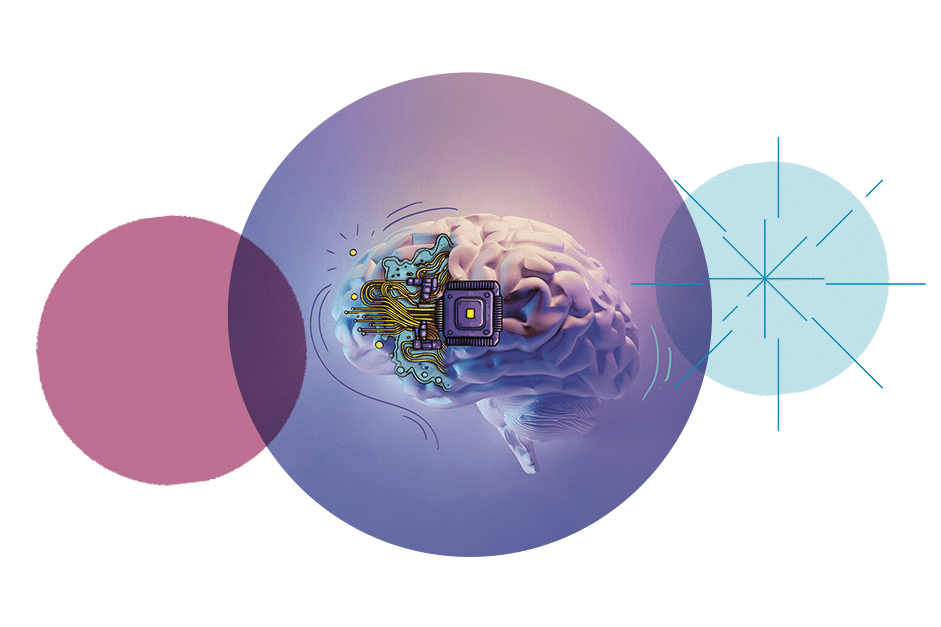
The idea that an AI system could detect a disease that appears nowhere in a patient’s medical record sounds like something from speculative fiction. At Volv Global, it is something we do today.
In brief
- Volv Global is featured in The Biopôle Review, published by Biopôle Lausanne, as part of an exploration of how science fiction has shaped real-world scientific innovation.
- Our machine learning methodology identifies undiagnosed and misdiagnosed patients at population scale – finding disease signals in real-world data where no diagnostic label exists.
- Earlier patient identification delivers measurable benefit across the full healthcare ecosystem: better outcomes for patients, stronger evidence for pharmaceutical development, and greater efficiency for health systems.
- Our reach across more than 400 million anonymised patient records means disease signals can be surfaced at a scale and precision no individual health system can achieve alone.
About the feature
The latest edition of The Biopôle Review, published by Biopôle Lausanne, explores the relationship between science fiction and real-world scientific innovation – and features Volv Global as one of the companies on the Biopôle campus whose work now occupies territory that imagination once claimed exclusively. The full article is available on the Biopôle website: Has science fiction inspired the scientific innovations of today?
What the article explores
The Biopôle Review traces the journey from canonical science fiction – Huxley’s Brave New World, Asimov’s I, Robot, Gibson’s Neuromancer, the regenerative medicine of Star Trek – to the operational realities now being developed on the Biopôle campus. It surveys five domains: genetics and cell therapy, autonomous machines and AI, brain-computer interfaces and implants, regenerative medicine, and synthetic biology. For each, it profiles companies whose work has moved from the realm of the imaginable to the demonstrably real.
The article’s central argument is that science and science fiction engage in a continuous, reciprocal exchange – each expanding what the other believes is possible. It is a compelling frame for the kind of work being done at Biopôle, where ambition and scientific rigour sit side by side. Volv Global is featured within the AI section of the piece, and the placement reflects a genuine alignment between the article’s central argument and the work we do.
The Volv Global angle
The most persistent gap in healthcare for patients living with rare or difficult-to-diagnose diseases is not a shortage of treatments. It is the failure to identify the right patients in the first place – and to identify them early enough for any intervention to make a meaningful difference. This is the problem our machine learning methodology was built to address.
We learn the pattern of a disease from labelled data – the cases that have been identified and documented – and then apply that understanding to population-scale real-world data where no such labels exist. The patients we surface are the ones who have been missed: individuals whose records carry no diagnostic code for the condition they have, but whose data, examined at the right scale and with the right methodology, reveals the signal. These are the undiagnosed and the misdiagnosed – people who may have spent years, sometimes decades, navigating a healthcare system that has not yet found the right answer for them. We detect them earlier than conventional approaches, and with a precision that population-scale analysis makes possible.
The consequences of finding these patients earlier are significant at every level. For the individual, it means access to appropriate care sooner. For pharmaceutical companies, it means a truer picture of the patient population – with direct implications for clinical development strategy, trial design, endpoint selection, and real-world evidence generation. For health systems, it means a reduction in the cost burden of prolonged, misdirected diagnostic journeys.
We work across more than 400 million patient records, held by trusted data partners in the UK, US, Germany, the Netherlands, and beyond – always anonymised, always privacy-first. Our work spans rare diseases, difficult-to-diagnose conditions, and diseases where significant care gaps persist despite relatively high prevalence.
Read the full Biopôle Review article here: Has science fiction inspired the scientific innovations of today?