Introduction
Advocacy plays a critical role in accelerating progress in rare diseases. As technology advances, collaboration between patient communities, researchers, healthcare systems, and innovators becomes essential to shorten diagnostic delays and ensure scientific breakthroughs translate into real patient benefit. This webinar discussion brought together experts from across healthcare, policy, and industry to explore how data and advocacy can work together to improve rare disease diagnosis and care.
Patient advocacy is where rare disease progress becomes accountable: it keeps innovation anchored to lived experience, focuses attention on equity, and accelerates the translation of science into better outcomes. In this Science/AAAS discussion from December, 2023, Volv Global’s Clinical Innovation Director Léon van Wouwe joined leaders across genomics, policy, and life-sciences strategy to explore how technology can shorten diagnostic odysseys, strengthen evidence, and improve access to the right care at the right time.
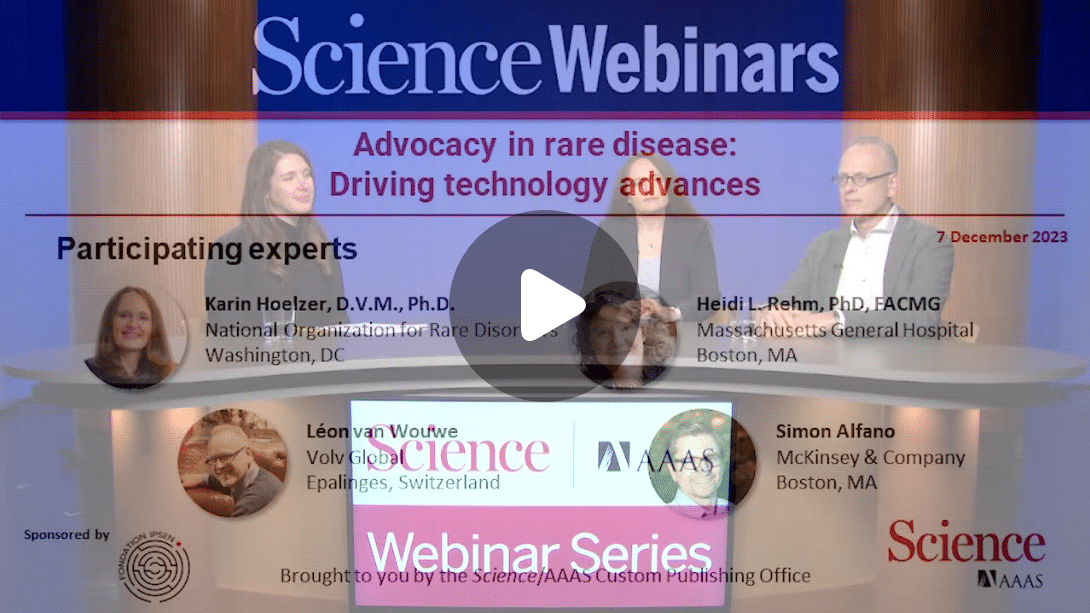
The webinar “Advocacy in rare disease: Driving technology advances” was sponsored by Fondation Ipsen and produced by the Science/AAAS Custom Publishing Office.
Panel:
-
Léon van Wouwe (Volv Global)
-
Heidi L. Rehm, PhD, FACMG (Massachusetts General Hospital)
-
Karin Hoelzer, DVM, PhD (National Organization for Rare Disorders, NORD)
-
Simon Alfano (McKinsey & Company)
-
Erika Gebel Berg, PhD (Science/AAAS) – moderator
“Many of our patients have to go through a diagnostic odyssey of five to seven years… which is horrific for the patients and their families.”
– Karin Hoelzer, Senior Director, Policy and Regulatory Affairs, NORD
Rare diseases expose the limits of siloed data and fragmented pathways. As Karin Hoelzer (NORD) outlines, patients often face a 5–7 year diagnostic odyssey, with scarce natural history data, heterogeneous presentation, and decentralised systems that make patients hard to find and trials hard to run.
Léon was invited as a panel expert alongside leaders from Massachusetts General Hospital, NORD, McKinsey & Company, and Science/AAAS. His perspective speaks directly to a core, recurring gap in rare disease: even when science advances, systems struggle to reflect “true” patient populations, link signals across fragmented records, and translate insight into action. In the discussion, Léon describes his focus as building “bridges” from real-world data into clinical development and patient care – exactly the connective tissue required to move from breakthrough to benefit.
“I am looking to build bridges between real-world data through technology into clinical development and patient care.”
– Léon Van Wouwe, Clinical Innovation Director, Volv Global
For us at Volv Global, advocacy is not peripheral. It is part of what makes technology meaningful and responsibly applied. We see “democratisation of patient data” as ensuring that patient experience is represented in the evidence base (and that insights can be translated into fairer decisions), while still protecting privacy and respecting stewardship.
Volv Global and patient advocacy: “where technology meets human”
At Volv Global, we view patient advocacy as non-optional, because better data without patient context can still miss what truly matters. Our work aims to support the wider rare-disease community by helping close diagnosis gaps and strengthening evidence for change, while respecting privacy and data stewardship.
This philosophy is echoed in voices we’ve hosted and collaborated with:
Links:
- Volv Global: We find more patients
- Volv Global: We find patients earlier
- Volv Global: We predict patient outcomes
- Volv Global: We stratify patient cohorts
Frequently ask questions
What was discussed in the “Advocacy in Rare Disease: Driving Technology Advances” webinar?
The webinar explored how patient advocacy, technology, and real-world data can help shorten diagnostic delays, improve evidence generation, and support better care pathways for people living with rare diseases.
Why is patient advocacy important in rare disease innovation?
Patient advocacy ensures that research, policy, and healthcare innovation remain grounded in real patient experiences, helping guide priorities around diagnosis, treatment access, and care improvements.
What role does technology play in rare disease diagnosis?
Technology and real-world data analytics can help identify patterns in large healthcare datasets, enabling earlier recognition of rare diseases and supporting more efficient clinical research.
Who participated in the webinar panel?
The panel included experts from Volv Global, Massachusetts General Hospital, the National Organization for Rare Disorders (NORD), McKinsey & Company, and Science/AAAS.
Advancing rare disease care requires collaboration between patient communities, clinicians, researchers, and technology innovators. Discussions like the one in this webinar highlight how advocacy and data-driven innovation can work together to shorten diagnostic journeys, strengthen evidence, and ultimately improve patient outcomes across the rare disease ecosystem.