
Finding the Patients We’re Missing
Rare diseases often remain undiagnosed for years, leaving patients without timely treatment and care. Despite advancements in healthcare and data analytics, a significant diagnostic gap persists across healthcare systems worldwide. Identifying these “hidden” patients earlier is critical to improving outcomes, reducing disease progression, and enabling more effective interventions. Bridging this gap requires a combination of clinical expertise, real-world data, and scalable healthcare solutions.
To better understand how healthcare systems are evolving to identify patients earlier, explore our approach to patient identification in healthcare
A thoughtful new conversation from Melody Joy Paine and her Rare Rebels™ podcast explores one of the most persistent challenges in rare disease: the reality that too many patients remain invisible inside the system.
In this episode, Leon van Wouwe, Volv Global’s Clinical Innovation Director, unpacks why the “diagnostic gap” is often a systems issue – missed patterns, fragmented journeys, and clinical bandwidth – rather than a lack of intent or an absence of innovation. The discussion is a grounded reminder that data-driven methods only matter when they support clinical judgement and can be translated responsibly into real workflows clinicians can trust.
As the diagnostic gap in rare diseases continues to impact patient outcomes, leveraging real-world data and advanced analytics is becoming essential to identify patients earlier within existing healthcare systems. By uncovering hidden patterns and improving clinical visibility, healthcare stakeholders can reduce delays in diagnosis and ensure more timely and effective interventions.
If you care about moving from awareness to action in rare disease, this is worth a listen, especially for teams working on:
- earlier recognition (before irreversible progression)
- finding patients already interacting with care, but still undiagnosed
- responsible adoption that respects real-world constraints and human decision-making
Thank you, Melody, for creating space for conversations that connect lived experience, clinical reality, and practical change.
Frequently Asked Questions
1. What does “finding undiagnosed patients” mean in rare diseases?
It refers to identifying patients who are already interacting with healthcare systems but have not yet received an accurate diagnosis.
2. Why do rare disease patients remain undiagnosed?
Patients often remain undiagnosed due to fragmented healthcare data, lack of awareness, and complex disease presentations that are difficult to identify early.
3. How can data help identify rare disease patients earlier?
Advanced analytics and machine learning can detect hidden patterns in healthcare data, enabling earlier identification of patients who may otherwise be missed.
4. What is the diagnostic gap in healthcare?
The diagnostic gap is the delay between symptom onset and accurate diagnosis, which can lead to disease progression and reduced treatment effectiveness.
5. How can healthcare systems reduce diagnostic delays?
By improving patient identification, integrating data sources, and using predictive analytics to support clinical decision-making.
6. Why is early diagnosis important in rare diseases?
Early diagnosis allows for timely treatment, better disease management, and improved patient outcomes.
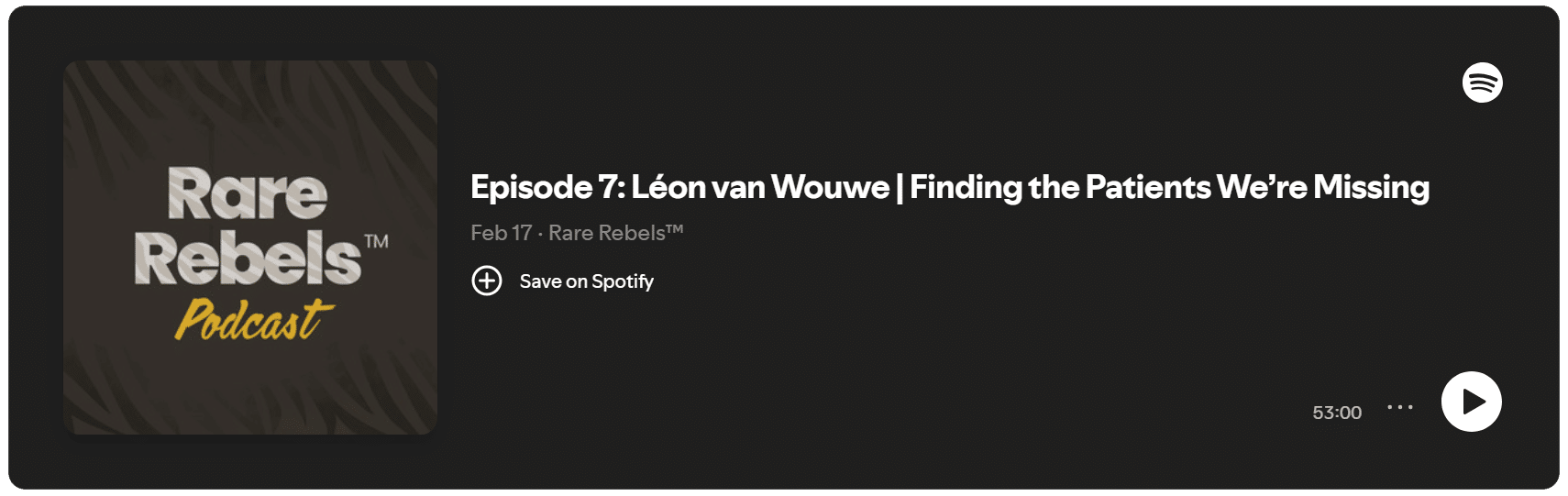
Please click to listen to the episode recording hosted on the Rare Rebels™ platform.
Podcast description:
Léon Van Wouwe works at the intersection of data science, healthcare systems, and rare disease. In this episode, we explore how machine learning can be used not as a shiny new technology, but as a practical tool to help clinicians recognize patients who are already in the system but remain undiagnosed.
Our conversation focuses on how patterns hidden in healthcare data can surface patients years earlier than traditional diagnostic pathways, why underdiagnosis is far more common than most people realize, and what it takes to move these insights from theory into real clinical workflows. We also talk about the human side of adoption, including clinician trust, system constraints, and why technology only works when it serves people.
This episode adds a critical infrastructure layer to the Rare Rebels™ map, showing how precision, specificity, and collaboration across stakeholders can shorten diagnostic timelines and open new possibilities for treatment and care.